




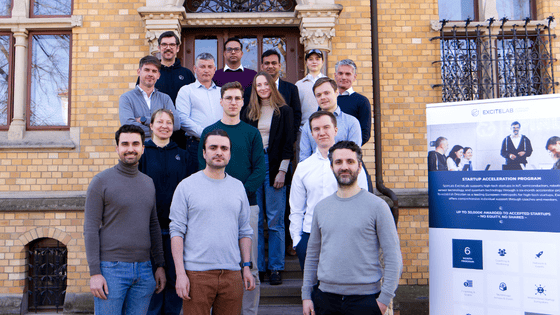
Supply chain sovereignty, artificial intelligence in industry, sustainable hardware, and resilient connectivity infrastructure are currently among the key industrial policy debates in Europe. The fourth batch of ExciteLab addresses these intersections: ten startups from Italy, Germany, Sweden, Norway, and the Czech Republic have now started the acceleration program in Dresden. In close collaboration with partners such as Infineon Technologies, ZEISS and Von Ardenne, the teams gain direct access to industrial expertise, infrastructure, and capital.
eMomentum | AI-powered predictive maintenance
Electric motors account for around 46 percent of global electricity consumption. eMomentum is developing an AI platform that monitors motor-driven equipment in real time and detects energy losses or wear at an early stage. Sensors can be installed in less than 15 minutes per system.
Flargo | Autonomous cargo aircraft
The company is developing an autonomous cargo aircraft with vertical take-off and landing capability (VTOL) that can transport up to 660 kilograms of payload. By using a rotating fuselage, the aircraft switches between vertical take-off like a helicopter and efficient horizontal flight like an airplane. The autonomous alternative to helicopters aims to make logistics in industry, construction, and disaster response more efficient.
Dappler Labs AB | Precision metrology for chip manufacturing
A spin-off from the KTH Royal Institute of Technology, Dappler Labs is developing an optical measurement system for semiconductor manufacturing. The technology measures tiny structures on silicon wafers with sub-nanometer precision—well below one billionth of a meter. Unlike established electron-beam methods, the system uses conventional optical microscopes combined with novel analysis algorithms. This approach aims to enable faster and more cost-efficient measurements.
SemiCopilot | AI copilot for chip designers
Developing a semiconductor often takes between 12 and 18 months. A large portion of this time is spent navigating tools, writing scripts, troubleshooting, and performing repetitive validation tasks in complex Electronic Design Automation (EDA) environments. SemiCopilot is building an AI assistance layer that integrates with existing design tools and supports engineers in typical workflows—for example through automated script suggestions, error analysis, documentation support, and context-based recommendations. The goal is to shorten development cycles and increase productivity.
air-Q | Real-time indoor air quality analysis
air-Q provides a sensor system for continuous monitoring of indoor air quality. The device measures up to 14 parameters simultaneously, including CO₂, particulate matter (PM2.5), radon, nitrogen oxides, and volatile organic compounds, updating readings roughly every two seconds. High-resolution data collection enables early detection of risks such as insufficient ventilation, elevated pollutant levels, or potential fire hazards. Integrated software analyzes the data in real time and provides concrete recommendations to improve indoor air quality.
Fast Sense | Precise gas measurement for hydrogen infrastructure
The integration of hydrogen into gas networks requires highly precise measurements. Fast Sense addresses this challenge with a semiconductor chip that measures the hydrogen-to-methane ratio in real time. Conventional sensors often struggle with fluctuating gas compositions and can deliver inaccurate results. Fast Sense aims to reduce these measurement errors and provide stable, precise readings—for example in distribution networks, industrial facilities, or any environment where the exact gas composition is critical for safety, control, and billing.
Neuron Soundware | AI-based acoustic monitoring of machines
Neuron Soundware uses artificial intelligence to monitor machines based solely on their sound. Sensors continuously capture acoustic signals from motors, pumps, or compressors. AI models analyze these sound patterns and detect deviations from normal operation. Trained on more than one billion audio data points, the system can identify wear, malfunctions, or potential failures early—often before they become visible in traditional vibration or temperature measurements. The technology is already deployed in 14 countries and aims to reduce unplanned downtime while enabling data-driven maintenance.
Rolog Solutions | Autonomous pallet lifters for flexible warehouses
Rolog Solutions develops modular autonomous pallet lifters capable of moving loads of up to 1,000 kilograms and reaching heights of up to four meters. The vehicles navigate warehouses independently. The solution is particularly designed for small and medium-sized warehouses, where traditional automation systems are often too expensive or inflexible. The goal is to gradually automate manual transport processes and improve efficiency in existing warehouse infrastructures without major structural changes.
Leaftronics | Biodegradable printed circuit boards
Leaftronics uses the natural cellular structure of leaves as a substrate for printed circuit boards and combines it with biodegradable polymers. The result is PCB substrates capable of supporting electronic components such as chips or OLEDs while remaining industrially compostable. Compared to conventional FR4 circuit boards, the approach is expected to significantly reduce the carbon footprint.
Last Mile Semiconductor | Wireless chips for industrial IoT networks
Last Mile Semiconductor develops wireless chips based on the DECT NR+ standard, enabling devices to communicate over distances of up to six kilometers without requiring mobile network contracts or recurring fees. The technology targets applications where large numbers of sensors need to be reliably connected, such as in factories, construction sites, or agriculture.
Do you also want to be part of this ecosystem? Follow us on LinkedIn to not miss the next application deadline.


/RootCamp_Logo-Ecosystem.png?width=200&name=RootCamp_Logo-Ecosystem.png)

/Bitroad_Logo-Ecosystem.png?width=200&name=Bitroad_Logo-Ecosystem.png)